
Layouts & workspaces
A layout is a named working scene: how the window is split, which folder each tab has open, and which view each one uses, all kept under one name. It suits going back and forth between "one set of folders for work, another for design" without opening everything again each time.
The important part: a layout saves itself when you switch away, and coming back looks exactly like when you left. There is no "Save changes?" dialog.
Think of each layout as its own monitor: whichever one you walk up to still looks the way you left it. You never have to remember to save.
What layouts can do
- Save the current window under a name.
- Switch to another set with one click in the sidebar.
- Start a fresh blank one, or begin from one of twelve split templates, setting the folder each pane opens in as you go.
- Rename, duplicate, delete, and drag to reorder.
- Lock one so it stops following your changes.
- Show the current layout's name in the window title, which helps in the taskbar.
The sidebar "Layouts" section
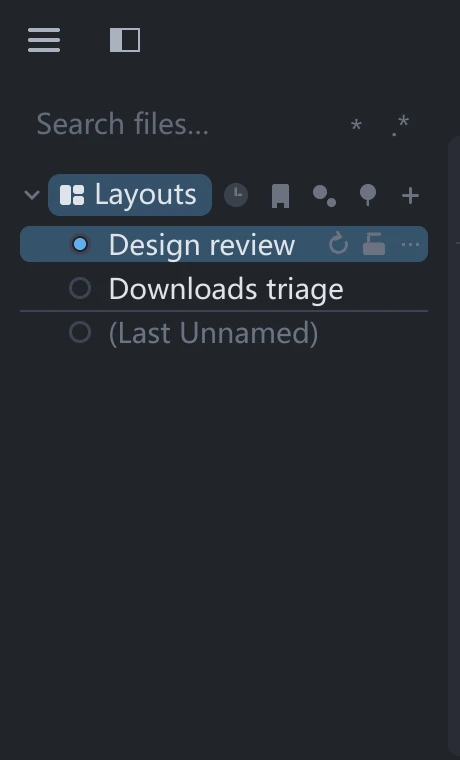
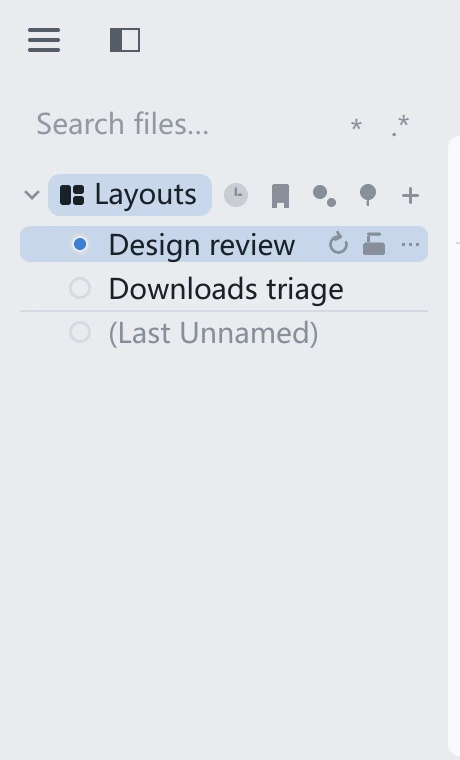
Select Layouts in the sidebar tab strip to open its component page. To keep other pages visible, move it to a separate sidebar pane or drag it into the main area; see Sidebar & component pages. It contains three kinds of rows:
| Row | What it means |
|---|---|
| A plain name | One you have saved; the filled dot marks the one you are in |
| (Current Layout) | Your current setup does not have a name yet. Clicking does nothing; give it a name and it is saved |
| (Last Unnamed) | Switch away before naming your setup and tessoa keeps it here, so you cannot lose it by accident |
(Last Unnamed) only appears when the setup was worth keeping. One you just opened and never moved out of the Start Page, or one identical to the layout you are switching to, does not take that row. Hover the row and the tooltip reads Your unsaved window scene · click to get it back · rename to keep it.
Saving your first one
Until you name it, (Current Layout) sits at the end of the Layouts page:
- Arrange the panes and tabs the way you want them.
- Choose Rename from that row's ⋯ menu and give it a name, for example "Design review".
- The setup is now a proper layout, and the one you are in.
You can also select Layouts, click + at the right end of its tab strip, and choose Save Current Window as Layout.
Starting from a template
When you would rather not build the split by hand, let a template lay the panes out — and set which folder each pane starts in while you are at it:
- Select the sidebar's Layouts page and click + at the right end of its tab strip.
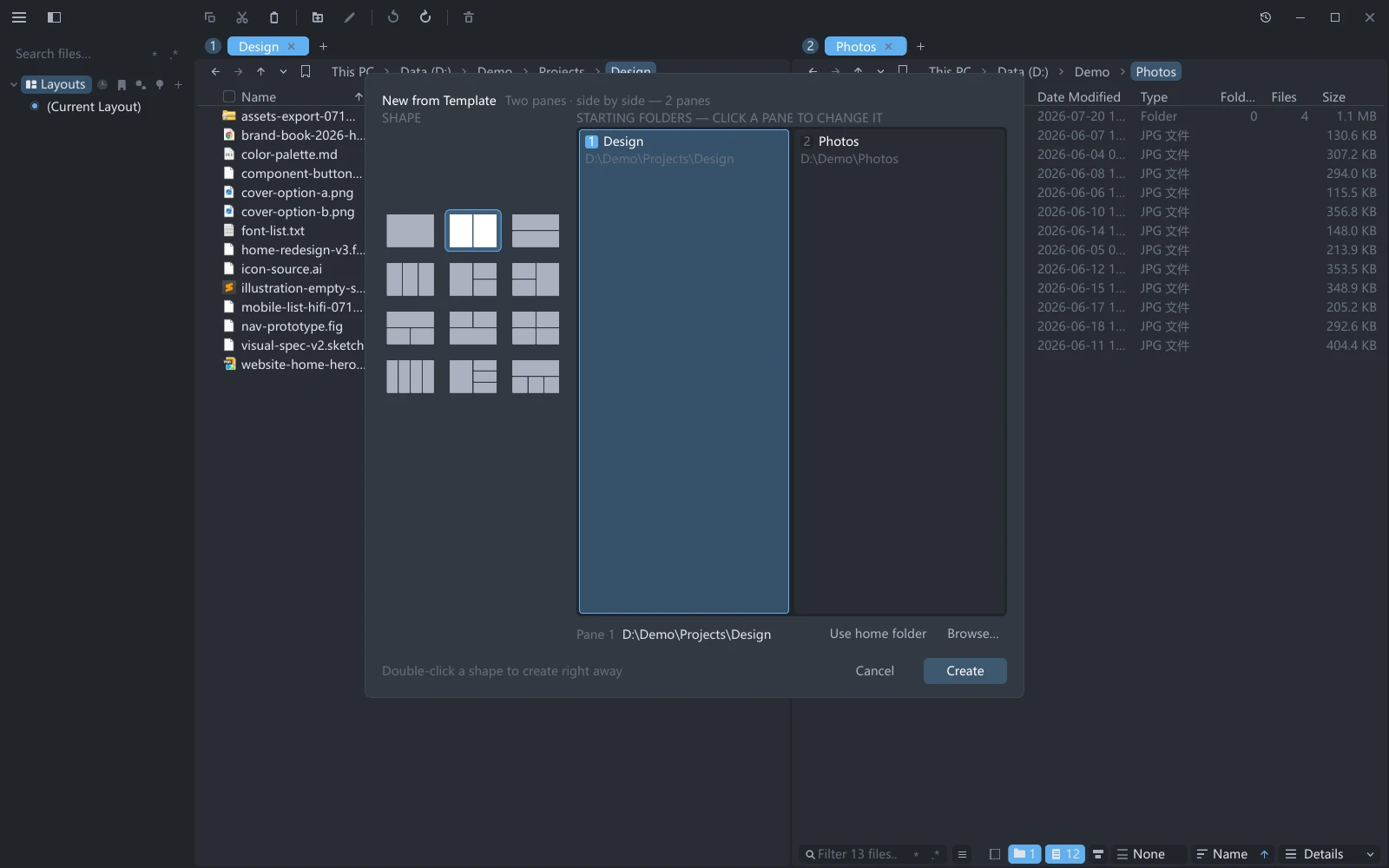
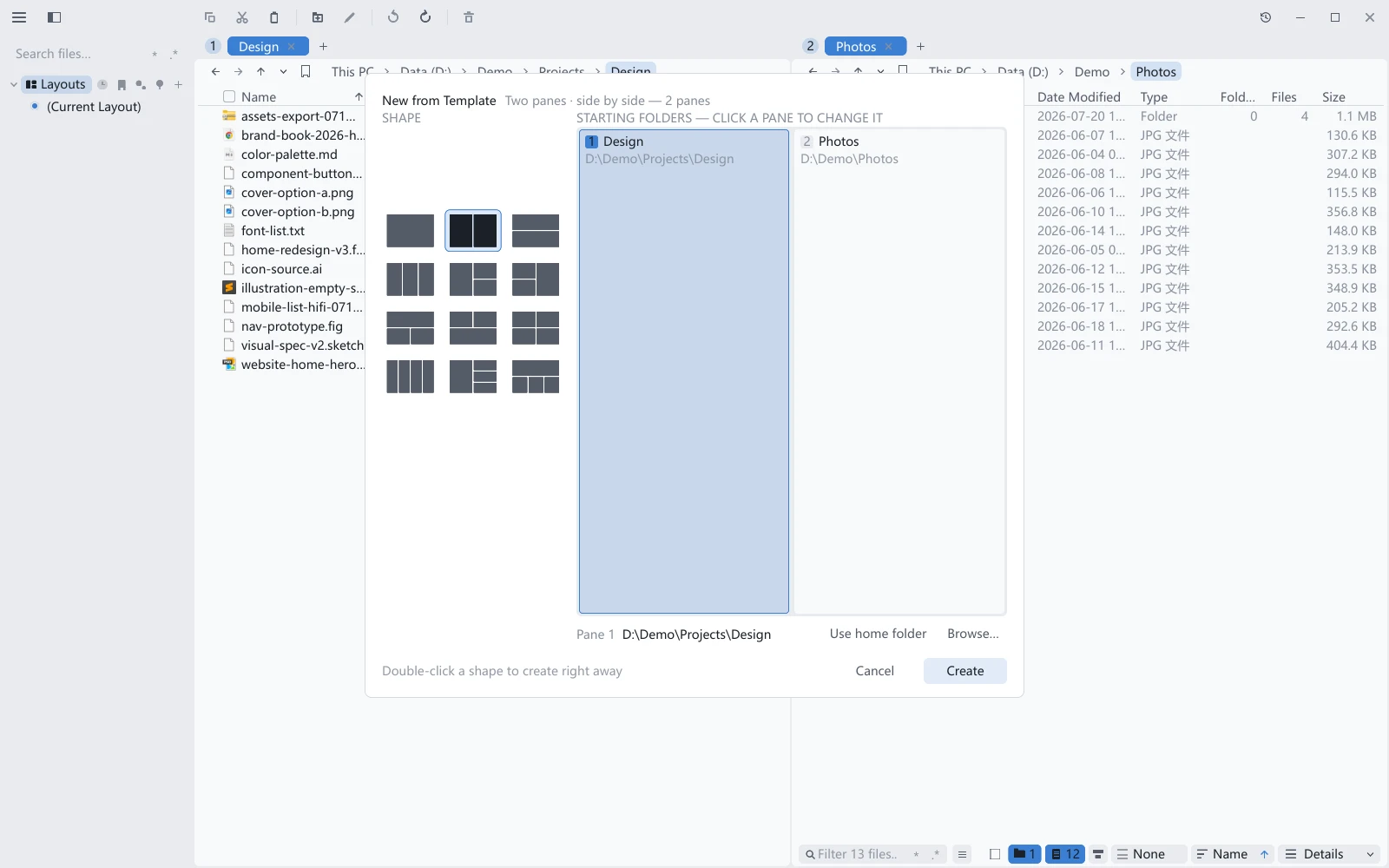
- Choose New from Template…; the New from Template dialog appears.
- Pick a shape in the Shape column on the left.
- Click a pane in the Starting folders — click a pane to change it column on the right to change where it opens.
- Click Create.
The left column offers twelve shapes, grouped by pane count:
| Panes | Arrangements |
|---|---|
| One | Single pane |
| Two | Two panes · side by side, Two panes · stacked |
| Three | Three panes · columns, Three · one left, two right, Three · two left, one right, Three · one top, two bottom, Three · two top, one bottom |
| Four | Four panes · grid, Four panes · columns, Four · one left, three right, Four · one top, three bottom |
The starting folder of each pane
The right column draws the shape you picked, with every pane labelled Pane 1, Pane 2 and so on, plus the folder it will open. Those folders are filled in the moment the dialog opens, from the folders your current window already has open, matched to the panes in order, with extras dropped and gaps filled with the default.
So this dialog can also be used to give the folders you have open a different shape: they carry over into the new layout, and only the pane shape changes. The layout you were on is saved automatically before the new one is created.
To change one pane:
| What you want | How |
|---|---|
| A different folder | Click that pane, or select it and click Browse… at the bottom, then pick one in the folder picker |
| Back to the home folder | Select the pane and click Use home folder |
| No folder of its own | Select the pane and press Delete; it then reads Home folder |
While the picker is open, small text beside its title reads Pane N to say which pane you are choosing for. The picker is the same size as the dialog and covers it completely.
Switching to another shape keeps the folders you filled in: go from four panes to two and back, and all four are still there.
Locations that cannot be reopened — inside an archive, a tag view, inside a phone — do not carry over; those panes fall back to the home folder. The Start Page and This PC carry over as they are.
Faster routes
- The folders are already filled in when the dialog opens, so pressing Enter straight away creates the layout.
- Double-click a shape to pick it and create in one go, without visiting Create. The dialog says so itself.
The whole dialog works from the keyboard:
| Key | What it does |
|---|---|
| ← → ↑ ↓ | Move among the twelve shapes |
| Tab / Shift+Tab | Cycle through the panes |
| Space | Choose a folder for the current pane |
| Delete | Return the current pane to the home folder |
| Enter | Create |
| Esc | Close without creating anything |
The new layout is named after the template ("Two panes · side by side", for example) and drops straight into rename mode, so typing replaces it. The name does not follow the first pane's folder.
Templates do not remember the folders you filled in last time. To keep a set of folders, use a layout: what you create here is an ordinary layout, saved automatically when you switch away and one click from coming back.
Switching layouts
Click another layout name in the sidebar. Three things happen:
- The one you leave: saved automatically, unless it is locked (see the next section).
- The one you go to: the whole window turns into how you last left it.
- If the one you leave has no name yet and you did arrange something in it: it goes into (Last Unnamed), and you can click back into it later.
Locking a layout
Saving on the way out is convenient most of the time, but some layouts you want left exactly as they are — a carefully tuned three-pane comparison, say. Lock those:
- Hover the row; an open padlock appears at its right edge, labelled Lock = treat as a template: changes are never written back.
- Click the padlock, or choose Lock Layout from the ⋯ menu.
A locked row shows a closed padlock at all times, with the tooltip Locked (template) · click to unlock; clicking it again unlocks.
Locking turns a layout into a template. You can still arrange it, open tabs in it and change views, but none of that is written back when you switch away — next time you come back it is how it was when you locked it.
Those changes are not lost. They go into (Last Unnamed), and one click on that row brings them back.
A locked layout cannot be deleted or overwritten with Save Current Window Here; both entries are greyed out in the menu, with the tooltip Layout is locked — use "Unlock layout" first to change it.
Reloading a layout
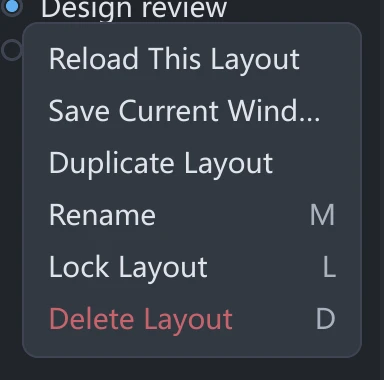
Because layouts save themselves on the way out, Reload This Layout is how you undo a round of rearranging:
- Hover the current row — the one with the filled dot — and a ↻ button appears at its right edge, labelled Reload: discard changes, return to the saved state.
- Click it, or choose Reload This Layout from the ⋯ menu.
Clicking the current row itself does not reload — you are already in it. A toast appears instead: You're already in "X" — to reload, click the refresh button ↻ on this row, pointing at the very ↻ above.
Your changes are not thrown away: they go into (Last Unnamed), the same place they land when you switch away from a locked layout, and one click on that row brings them back.
Load This Layout and Reload This Layout share one slot in the ⋯ menu, and which one you get depends on the row: another layout offers Load This Layout (the same thing as clicking the row), while the one you are currently in offers Reload This Layout.
Other actions
The ⋯ menu on a row and the + menu at the right end of the tab strip hold the rest:
| Action | What happens |
|---|---|
| Save Current Window as Layout | + menu: saves the window as a new layout and switches into it |
| New Blank Layout | + menu: your current setup is saved first, then the window goes back to the Start Page |
| Load This Layout | Switches to the layout you opened the menu on — the same thing as clicking the row |
| Reload This Layout | Only on the layout you are in, see Reloading a layout |
| Save Current Window Here | Overwrites the layout you opened the menu on with the window as it is now. A message with an undo button follows |
| Duplicate Layout | Puts a copy right below the original and drops straight into renaming it |
| Rename | Double-clicking the name does the same thing |
| Delete Layout | If you delete the one you are in, nothing in the window closes; you simply go back to being unnamed |
| Reorder | Drag the row where you want it and let go |
How this differs from "restore last session"
These two get mixed up often, so here is the difference:
- Restore last session: quit and reopen, and you are back where you were. It happens automatically.
- Layouts: several named setups that you switch between yourself.
The two do not conflict. Your current layout is also saved on quit, so switching back and forth after a restart will not lose the changes you made before closing.
Sidebar width, page order, stacked panes and collapsed state are saved with the window session; switching named layouts does not replace that arrangement. Sidebar component tabs placed in the main area are saved and restored as tabs within a layout. See Saved state and version compatibility.